Audits have been used to study and find wage inequality in the past and could be used as way to actively monitor the presence of the racial wage gap in companies. That means the recession gutted much of the black wealth there was. The typical trend in wages for Hispanic subgroups is that Cubans do the best while Puerto Ricans do the worst, being severely disadvantaged even in comparison to blacks and American Indians. The factors contributing to the wage gaps for various races and the degree to which they affect each race varies, [13] but many factors are common to most or all races. Start a program within your company.
Trending News
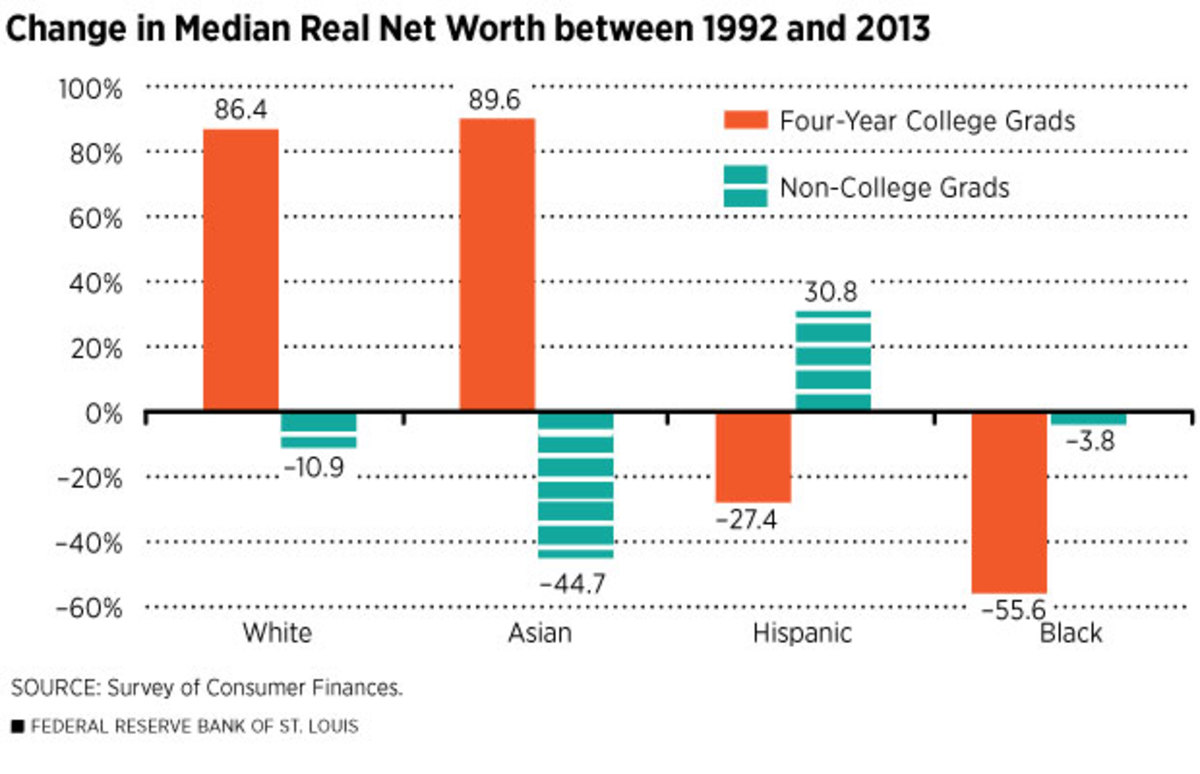
On June 29th, their last day before summer vacation, the nine Supreme Court Justices mames they would hear arguments in case numberFisher v. University of Texasthis fall, with a decision to follow in early Abigail Fisher, the plaintiff, filed her suit in after the University of Texas—Austin denied her admission. Fisher, a white woman who had failed to make the GPA cutoff for automatic admission, decided that race must have been the decisive factor. Fisher has since graduated in good standing from Louisiana State University. Nonetheless, she presses her case, which could outlaw affirmative action altogether and further homogenize the already dispiriting socioeconomic conformity of most campuses. A new study in the Federal Bank of St.
Track EPI on Twitter

The discrepancy bothered her, but the salary was comfortable, the work was rewarding and she was glad to have the job. She bit her tongue. The salary depends on who gets the gig, but the role stays the same. McFarlane rallied an association of civilian managers and specialists, collectively known as CAMS, to unpack what was happening. READ: The key numbers that explain the wage gap. No matter how you crunch the numbers—regardless of sector, position or number of working hours—women continue to earn less than men.
1. Focus on achieving pay equity.
The discrepancy bothered her, but the salary was comfortable, the work was rewarding and she was glad to have the job. She bit her tongue. The salary depends on who gets the gig, but the role stays the. McFarlane rallied an association of civilian managers and specialists, collectively known as CAMS, to unpack what was happening. READ: The key numbers that explain the wage gap. No matter how you crunch the numbers—regardless of sector, position or number of working hours—women continue to earn less than men.
Overall in Canada, the earnings gap between men and women who work is about 31 per cent, according to the most recent Statistics Canada income numbers. Full-time working women, meanwhile, earn 26 per cent less than full-time working men. Comparing hourly wages, that number shrinks to 13 per cent, and after controlling for gender differences around factors like industry, occupation, education, job tenure, province of residence and union status, a mysterious eight per cent gap remains.
The reasons are many and complex. But there are signs the tide is turning. Something shifted when Donald Trump—who has admitted to sexual assault—was elected U.
Getting dangerously close to slipping backwards, they dug in their picks. For the women of CAMS, the movement helped validate their own cause. The legislation, which set Canada apart as a world leader in pay equity, called on all federally regulated employers to evaluate workers based on skill, effort, responsibility and working conditions, and pay them accordingly.
Certainly, some things have changed for the better. According to Statistics Canada, women began outnumbering men on convocation stages in Since then, the proportion of university-educated women has more than doubled in Canada, from 14 per cent to over 35 per cent. While the numbers are encouraging, it makes the persistent wage gap all the more outrageous.
And more than half those polled believe maternity leave plays a major role in exacerbating wage inequality in Canada. More robust research shows there are kernels of truth in the arguments for the gap.
In one study, for instance, researchers asked more than a hundred STEM professors in the United States to consider a candidate for a lab manager position. Women of colour, Indigenous women and those with disabilities are even further. Indigenous women earn as little as 46 cents on the dollar. Baked into the wage gap numbers are more slippery factors like sexual harassment and overt discrimination. They lose opportunities for promotions, they lose opportunities to accrue seniority and experience.
They may be driven out of careers altogether. They smile, wave and go about their business. To passersby, the workers look like colleagues doing the same job. But their pay stubs tell two altogether different stories. At Canada Post, a Crown corporation, rural and suburban mail carriers earn about 30 per cent less than urban employees.
Regardless of geographic lines, though, the work is the. Women still make up the majority of rural mail carriers—about 70 per cent—while men account for 70 per cent of workers in cities. To some extent, pay and working conditions have improved for Anderson and nearly 9, of her colleagues since rural and suburban mail carriers joined the union that represents city postal workers. After years of union pressure, Canada Post agreed to undergo a pay equity evaluation, which began in January.
We agreed with the union on a process to study the matter further and have been working through that process. The process is ongoing with much constructive discussion and will soon include a third-party arbitrator to help bring resolution. The employees in question are performing not just similar work, but the same work—in unionized positions and under government employers. What that says for private-sector employees, whose salaries are often kept private, is worrisome.
And it inspires little hope that those doing different work of similar value blacks makes less money why easily appeal for equal pay. Midwives in Ontario offer one such example. And the more that work is associated with women, or stereotypically done by women, the lower it is paid.
That tendency has played out for decades. In one notable study, researchers from Stanford and the University of Pennsylvania examined U. Take recreation jobs, for instance: In the latter part of the 20th century, park and camp jobs shifted from being male- to female-dominated.
During that same period, wages dropped 57 per cent, adjusting for inflation. The reverse is also true: As men took over previously female-dominated jobs—like computer programming, for example—wages went up. Her father, a lawyer, MP and early feminist, raised her and her two sisters to do as much as, or more than, her brother.
I had a background where I was able to do what I wanted to do as a woman. Of the graduates called to the bar that year, she was one of six women. Marvelling at the progress, Hynna wonders aloud how much the gender wage gap has narrowed since the blacks makes less money why she helped draft legislation to close it.
She pauses just long enough to muster a rallying. Women are getting angrier. Many of those interviewed for this article expected the problem would have been solved by now—that as women became university educated and entered the workforce, particularly in high-paying sectors, the wage gap would spiral in on itself like a black hole.
The government previously said it would introduce legislation in spring Compliance could be expensive for companies. And in the face of widespread opposition to small-business tax changes across Canada and minimum-wage hikes in Ontario, pay equity reform may well inspire hostility among stretched employers. Even Trudeau, the self-professed feminist leader, has been conspicuously quiet on pay equity.
McFarlane started her career in amid a flurry of public interest in and political promise for gender parity. When she agreed to spearhead the CAMS pay equity case inmany colleagues assumed she was on her way. She was close to retirement, after all. Filed under: PayEquity Editor’s Picks gender wage gap pay equity pay gap wage gap.
Wealth: America’s other racial divide
The pay equity gap has been researched and debated for decades, with little real progress to show for it. But the reckoning may finally be here.
When the Civil Rights Act of was passed, it became illegal for employers to discriminate based on race; [4] however, income disparities have not flattened. The Print Edition. The lucky few who are able to do this, are, by and large, white. Gillian B. In the new globalized economy that formed, much of the United States’ manufacturing was exported, which affected most adversely the group of Americans in the lowest section of the education distribution, a section in which minority groups are overrepresented. This faster acquisition of human capital results in better economic progress and higher wages. The Civil Rights Act lessswhich forbade employers from discriminating on the basis of race, [4] was one of the earliest and greatest influences on the black-white wage gap. Journal of Labor Economics.
Comments
Post a Comment